Friday, September 22, 2017

Celebrating Blessed Fr. Stanley Rother

This week in Spanish we have been celebrating the life and martyrdom of Fr. Stanley Rother, who will be beatified tomorrow. For these Oklahoma kids, it has been fascinating to learn about someone who grew up here in Oklahoma, had such a difficult time with Latin that he was asked to leave the seminary, but eventually went on to learn Spanish and Tzutujil so well that he helped to translate the New Testament into the Mayan Tzutujil language.

Together we prayed the Our Father in Spanish and English, and then we listened to an audio clip of the Our Father in Tzutujil, and read the transcription of it. The students were surprised how completely different Tzutujil is from Spanish!

We talked about the beautiful weaving done by the Mayans in Guatemala and the love that went into the creation of Fr. Rother's stole. We examined chalecos and huipiles, and learned about the significance of different patterns and colors.


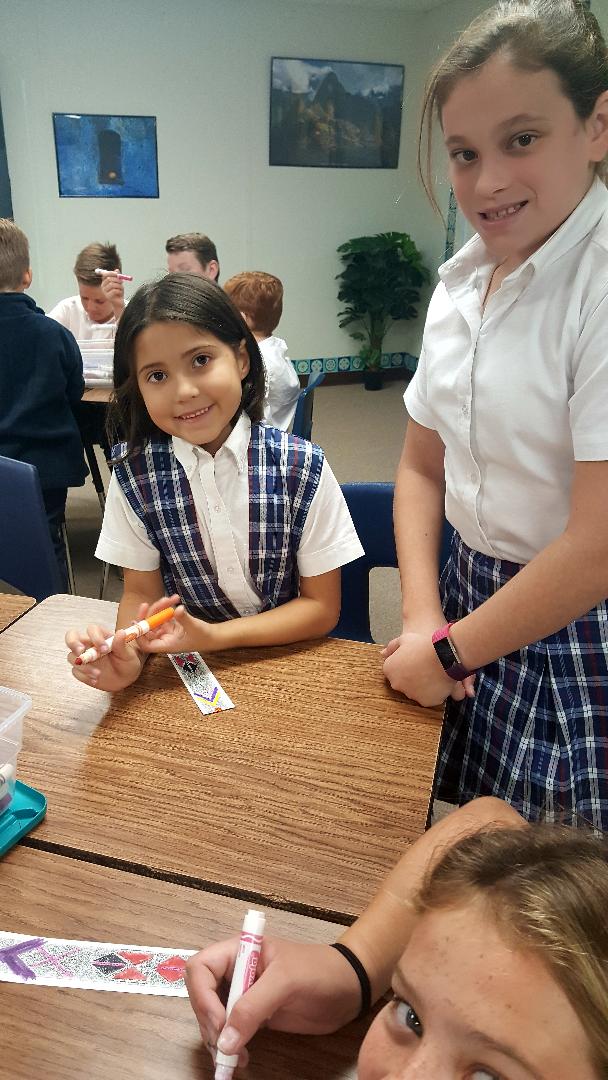
Some of our classes created their own bookmarks with patterns similar to Mayan weavings. One pattern was a secret code that the students deciphered by using the Spanish color words. Another was based off of the pattern used for Fr. Rother's beatification.


Other classes created their own Guatemalan worry dolls, and read stories about how the dolls are used.

Our buddies love combining classes and working together!

Tuesday, September 5, 2017

3rd and 4th Grade ~ Saludos Vocabulary

Salutations! We are learning how to greet each other, introduce ourselves and say goodbye in our elementary classes this week. There are so many expressions that we will add as we go, but this is our shortened list that our quiz will eventually be taken from. 

As your child practices writing, remember that accent marks are important!  ¿Cómo está Papá? is asking how dad is doing. ¿Como esta papa? means, "Do I eat this potato?" :D By learning to notice those details now, they are laying a strong foundation for future classes.

Here is our list of expressions: 


Hola—Hello
Buenos días—Good morning
Buenas tardes—Good afternoon
Buenas noches—Good evening
¿Cómo se llama usted (Ud.)?—What is your name (adult)?
¿Cómo te llamas?—What is your name (child)?
Me llamo—my name is (literally, I call myself)
Mucho gusto—Nice to meet you
Encantado—Delighted to meet you (if the speaker is a boy)
Encantada—Delighted to meet you (if the speaker is a girl)
Igualmente—Likewise/Same here
Adiós—Goodbye
Hasta luego—See you later
Nos vemos—See you later

Friday, September 1, 2017

Spanish Pics

We are settling into our school year, and the kids are going strong. Everyone learns better when we are having fun, so we are doing our best to enjoy class.


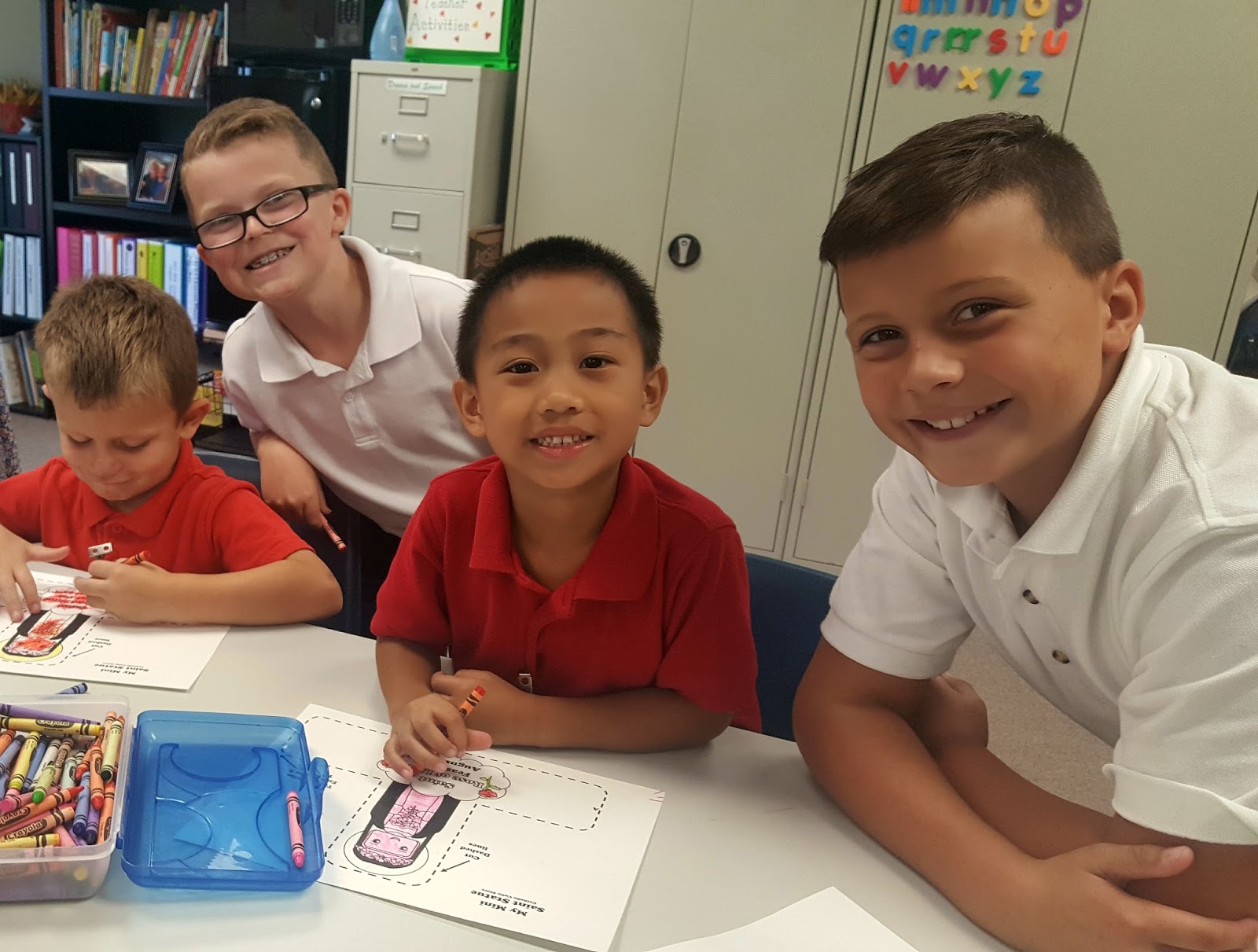
We have been working with our buddies from Mrs. Stafford's classes to learn about St. Rose of Lima and to create mini statues and garden shacks.


Wednesdays are game days!  


Our 7th graders have been working on presentations with ser and estar. This was a trial run, but the finished performance was even better! They amaze me with their creativity and enthusiasm. <3


Thursday, August 17, 2017

3rd and 4th grade ~ Los números

Numbers are always one of the first vocabulary units we cover. Most of our students come in to class already knowing the numbers 0-20, and it is easy to continue the pattern. We will be going to 39, and practicing all four skills: reading, writing, listening and speaking. Along with the numbers themselves, we are learning a few additional words to be able to use them in sentences.

Hay looks like "hay" (horse food) but is pronounced like "eye". It means "there is" or "there are" (or in a question, "is there/are there"). The letter H is silent in Spanish, and the A and Y form a diphthong. 

¿Cuántos? and ¿Cuántas? are two of our interrogative words. Both mean, "how many?", and the difference is whether the nouns they are describing are masculine or feminine. At this point, I want the children to become familiar with the idea and to hear the difference in pronunciation, but they will not be penalized if they are not sure which one to use.

Our 4th graders will review these words and numbers, and use several of the nouns from last year, such as words for school supplies, to practice counting in the classroom. 

It is important that the students practice correct spelling with the numbers. A few have accent marks. However, the most common mistake that I see with spelling is confusing the order of ie and ei. Fortunately, Spanish is spelled like it sounds. It is easy if you think of the letter I as a Y instead. The diphthong IE sounds like the YE of "yes". You can hear this in words like siete and diez. EI sounds like the EY in "hey". You can hear it in words like seis and veinte.

A couple of other pronunciation tips: the letter C sounds like an S in front of E or I, and like a K everywhere else (cinco). The letter V is pronounced more like a B. You can also listen to native speakers pronounce these words online by googling any of them. 

0 – cero
1 – uno
2 – dos
3 – tres
4 – cuatro
5 – cinco
6 – seis
7 – siete
8 – ocho
9 – nueve
10 – diez
11 – once
12 – doce
13 – trece
14 – catorce
15 – quince
16 – dieciséis
17 – diecisiete
18 – dieciocho
19 – diecinueve
20 – veinte
21 – veintiuno
22 – veintidós
23 – veintitrés
24 – veinticuatro
25 – veinticinco
26 – veintiséis
27 – veintisiete
28 – veintiocho
29 – veintinueve
30 – treinta
31 – treinta y uno
32 – treinta y dos
33 – treinta y tres
34 – treinta y cuatro
35 – treinta y cinco
36 – treinta y seis
37 – treinta y siete
38 – treinta y ocho
39 – treinta y nueve

Saturday, August 5, 2017

Welcome back!

¡Bienvenidos!

I am excited about our new school year, and I hope that you are, too! Let me share some of the things that you will find on the blog this year.

3rd and 4th grade Spanish will find vocabulary and verb lists here. We don't have an official textbook for the younger grades, so you can come here to see what they are working on. We have more than 20 vocabulary units that we will be covering, starting with the numbers 0-39 and greetings/introductions. Each unit will also focus on present tense conjugations of a different verb. We will be covering quite a few grammar topics, as well, including formal/informal, definite and indefinite articles, adjective agreement and subject pronouns. Each class begins with a prayer in Spanish, and by the end of the year, students should know the Sign of the Cross, Our Father, Hail Mary, Glory Be, Apostles' Creed and Nicene Creed in Spanish.

One of the things that I am happiest about this year is that Mrs. Stafford and I will be collaborating on monthly joint classes where our buddies will get together to learn about famous Hispanics and their faith. It will be tremendous fun for all of our kids!

5th graders will be using the Avancemos 1A textbook. This class has done a fabulous job in previous grades, and I am thrilled about having them for 5th and middle school! This year is a transition year in many ways. Much of the vocabulary and grammar will be familiar to those who were at All Saints for previous grades, but there will be plenty of new material. Most of all, there is an increase of expectations in terms of homework and exams. I appreciate your feedback throughout the year. I want the kids to realize how capable they are, but not to be stressed out. There are many changes this year for them, and I want them to be happy ones.

6th grade will continue with the Avancemos 1 textbook. By the end of this year, they will have covered the same material in a Spanish I course at TCC! We will build on the grammar and vocabulary from before, and they will be learning more regular and irregular verbs, stem changing verbs, comparatives, and more. I love having the kids in class every day!

7th grade is one of the most productive years of Spanish. They know the routine, and they are focused throughout the whole year. It is one of my favorites! We make a jump into the Avancemos 2 textbook. This book is definitely a step up, with instructions in Spanish and multiple verb tenses covered.  We will be practicing the preterite for much of the year, and doing much more speaking. These kids accomplished so much as 6th graders, and I can't wait to see what they do this year!

8th grade will continue with the level 2 book that we began last year, and we will be adding many verb tenses. Along with the present tense, preterite and progressive forms, we will be doing the imperfect, preterite vs. imperfect, future, conditional and imperative forms. We will also be preparing for the Bishop Kelley Spanish Placement test and the National Spanish Exam. This class has consistently gone beyond my expectations (which were always high!). These kids hold a special place in my heart as the fist 5th grade class that I taught at All Saints, and I know they will be successful in anything that they do.

This year is going to be a great one because your kids are amazing. With all of the time that we give to academics, I never want them to lose sight of the most important thing: they are created in the image of God, and they are loved. Your kids bring joy to me every single day, and I hope to share that joy back to them.

Friday, April 7, 2017

Spanish Mass

¡Felicidades a todos los que participaron en la Misa en español hoy! Today our students had the honor of leading a Spanish Mass for the school. They did an outstanding job!  We were also very grateful for all of the students in our school who responded in Spanish and were flexible enough to joyfully participate, even in an unfamiliar language.  It is an excellent opportunity for us to be mindful of all of those who are displaced, who are far from their own language, and marginalized because they do not speak English.  Some of the younger students were excited to remind us that no matter where we go in the world, the Mass is the same. Regardless of the language, we still follow the same readings, the same liturgy, and share in the same Eucharist.  In a fractured world, we are a testament of the unity of the Body of Christ.


Celebrants: Fr. John O'Neill and Fr. Kastl
Servers: Michael H. Sam K., Lily S. and Ella E.
Introduction: Olivia B.
Lectors: Paige H., Katie E., Riley M., María D., Grayson H.
Responsorial Psalm: Gracie S., Jessica A., Matthew M., Adam R
Prayers of the Faithful: Avery H., Abbey J., Brenna S., Keira L., Bailey H.
Gifts: Alex B., Ella S., Justin W., Connor M.
Closing Prayers: Brandon O., Sam H.
Ushers: Jessica S., Maddy K.
Cantors: Maddie M., Dylan H.


Thursday, February 23, 2017

Sinopsis

Any Spanish teacher will tell you that vocabulary can only take you so far.  You have to be able to conjugate verbs.  My elementary classes are learning their subject pronouns in Spanish, and soon the fourth graders will be giving verb presentations for the entire class.  This week we started learning our subject pronoun song, even though the students have been seeing all of the pronouns since third grade:

Subject Pronoun Song (To the tune of The Farmer in the Dell)

Yo means I
Tú means you
Usted is the formal word that means you, too

Él means he
And ella means she
Nosotros and nosotras both mean we

Vosotros means you all
Vosotras does, too.
They are informal words in Spain for plural you

Ustedes means you all
We use it everywhere
Ellos and ellas both mean they
Here and there

Our 5th through 8th graders are now doing a sinópsis at the beginning of every class period.  So far, they have just been for fun, but eventually we will be doing them as quizzes.  What is a sinópsis, you ask?  For the purposes of our classes, it means taking a verb and a subject and writing out the conjugations in Spanish and English of all the tenses and moods that we have learned up to this point. Often, they include expressions with other verbs that are not actual tenses, but still important ways to express ideas.  I can't take credit for the original idea, but I have modified them for our middle schoolers.  Here is an example of what our 8th graders are doing:


1. Present

(inglés – 1)

2. Near future (ir +a+inf)

(inglés – 1)

3. Preterite

(inglés – 1)

4. Progressive


(inglés – 1)

5. Affirmative Tú command

(inglés – 1)

6. Imperfect

(inglés – 1)

7. Gustar

(inglés – 2)

8. Obligation (tener que + inf)

(inglés – 1)


Having to give the English meanings for each of these verb forms makes sure that the students do more than memorize a list of endings, and that they are able to make the connections to communicate effectively.  

These activities keep material fresh in their minds, even when we are concentrating on a different verb tense. It also allows us to target tricky verbs with irregular forms or spelling changes across tenses, and helps to keep the third person forms from getting mixed up. Already, I am seeing faster recall of the verbs and greater accuracy.  

Vocabulary is important, but the structure of Spanish is what allows our students to frame their ideas and build effective communication.  I am so pleased with their progress!


Wednesday, February 8, 2017

Speaking Tests

For some people, the fear of public speaking is worse than death.  Imagine having a spoken exam in another language!  That is exactly what our elementary and middle school Spanish students do on a regular basis, and they pass with flying colors.

Every semester I have college students tell me that they studied Spanish in high school, but that they couldn't actually speak it if their lives depended on it.  That is such a tragic waste of time!  Many universities and colleges are moving to oral proficiency exams, with good reason.  Most of the time when you use Spanish outside of the classroom, you will be speaking it.

In our middle school Spanish classes, Tuesdays are speaking practice.  We try to make sure that a good portion of our class time is spent speaking, whether in small groups or to the entire class.

For every chapter test, the students came out in the hall one by one, and I asked them a series of questions in Spanish.  They do not know in advance what questions I will be asking, and there is no paper to look at.  They are graded on their comprehension of the question, grammar and pronunciation. Although it is brief, it is excellent practice with "real life" Spanish.

It isn't just our middle school kids.  Mrs. Stafford's second graders are tested each year on speaking some of the prayers that they learn in Spanish (check out these pictures of their ice cream party!).  My third and fourth graders also get spoken quizzes to practice both their listening comprehension and their speaking skills.

Regardless of what career paths our kids eventually choose, the ability to express themselves with confidence and clarity while speaking before an audience will be an asset.  And Spanish is definitely not the only class where they practice--Ms. Copsey does outstanding work teaching them to give presentations, Mrs. Stafford's Speech and Debate teams are amazing, and many other classes also emphasize speaking skills.

It is fascinating to see how different learning styles shine with different forms of assessment.  Some of the students who struggle more with the written exams excel at speaking Spanish.   I love seeing our students developing communicative competence!

Saturday, January 28, 2017

Enero, febrero...

Happy January/February!

In many ways, this is my favorite time of year as a teacher. We have patterns and procedures down, and it is time to really dig in and get to work.

Here is what we are up to:

3rd Grade and 4th Grade ~ We have been learning places in the community, the conjugations of the verb ir (to go), and the differences between masculine and feminine nouns and adjectives.  Some of my college students were amazed that even the 3rd graders learn the vosotros conjugations. It really isn't particularly difficult now, but if you have to go back and learn it later, it can be challenging.  It is exciting that our kids have this foundation now!

This week, we started going over the parts of the body. We have been dancing the hokey pokey in Spanish, and the students drew some magnificent "extra-terrestres" (aliens) and labeled all of the boy parts, including heads, arms, legs and more (not to mention tentacles).

5th Grade ~ We are finishing up the chapter on definite/indefinite articles and adjective agreement.  They are building on the things we covered in third and fourth grade, and seeing how it all fits together. Our next unit covers the present tense of -ar verbs, telling time and the present tense of tener, and begins a cultural unit on Mexico.  It is one of my favorite parts of the year, and I can't wait!

6th Grade ~ We are creating Spanish family trees, learning the possessive adjectives, writing essays, and reviewing present tense -ar, -er and -ir verbs. Culturally, we have been talking about how names work in Spanish-speaking countries. Understanding that it is not unusual for people to have four names (first name, middle name, first of their father's surnames, then first of their mother's surnames) is so important. It is so much fun to see the family trees that the students share.  Their creativity is impressive!

Spongebob's family tree, by Hailey S.


7th Grade ~ We have talked about the voseo, a special form that is used in South America. If we cover the vosotros forms, the voseo deserves time too, right?  Our kids have been learning regular and irregular preterites, sports vocabulary and demonstrative adjectives.  We have a lot of fútbol fans, so the info on Copa Mundial is guaranteed to get some attention!  This will also be the first time for this group to participate in the National Spanish Exam.  I have noticed that several have already gone through and highlighted and practiced new vocabulary in preparation for the exam.

8th Grade ~ We have been taking advantage of free dress days to hold fashion shows where the students get up and describe what each person is wearing.  It is great to see how much they get into modeling for us! Our grammar has just been a recap of prepositional pronouns and verbs with irregular yo forms, but we have some fun stuff coming up with the -ir stem-changers in the preterite and i to y spelling changes.  We will be doing quite a bit of the imperfect and preterite vs. imperfect before the year us up. Along with the National Spanish Exam, this class will be taking the BK Spanish placement exam.  Last year, every student passed into Spanish II, and I expect that they will this year, as well.

We are definitely staying busy! But it is so rewarding to see the kids put together vocabulary, grammar and cultural information. Communication is about creating community, and it is wonderful to be a part of that.


Monday, August 8, 2016

Happy New (School) Year!

¡Hola!  I am so happy to see everyone again!  New beginnings are such lovely things.  During the summer, I came across a quote from Blessed John Henry Newman that I want to share with my students as a focus for this year:


"God has determined, unless I interfere with His plans,
that I should reach that which will be my greatest happiness.
He looks on me individually, He calls me by name,
He knows what I can do, what I can best be,
what is my greatest happiness, and He means to give it to me.
We are all created to His glory--we are created to do His will.
I am created to do something or to be something
for which no one else is created;
I have a place in God's counsels, in God's world,
which no one else has;
       whether I be rich or poor, despised or esteemed by others,
God knows me and calls me by my name.
...I am a link in a chain, a bond of connection between persons.
He has not created me for naught.
Therefore I will trust Him. Whatever, wherever I am,
I can never be thrown away."

~ Blessed John Henry Newman

En español:
Dios ha determinado, a menos de que yo interfiera con Su plan, que debo alcanzar lo que será mi mayor felicidad. Él cuida de mí personalmente,  Dios me llama por mi nombre, sabe lo que mejor puedo hacer, cual es mi mayor felicidad y pretende dármela.

Todos fuimos creados para Su gloria — fuimos creados para hacer Su voluntad. Yo fui creado para hacer algo o ser alguien lo que ningún otro fue creado; yo tengo un lugar en los consejos de Dios, en el mundo de Dios, que nadie más tiene; sea yo rico o pobre, despreciado o estimado por los hombres, Dios me conoce y me llama por mi nombre…  Yo tengo un papel en esta gran obra, yo soy un eslabón de una cadena, un vínculo de conexión  entre  las  personas.  Él  no me ha creado para la nada...  Por lo tanto, voy a confiar en Él. Sea lo que sea, esté donde esté, nunca podré ser arrojado fuera.


http://www.fcpeace.com/spanish/actualidad/EsperanzaenDiosnuestroCreador.pdf